

 August 28, 2026
 PRAKASH THIYAGARAJAN
“The global footprint of Indian Capability Centres is undergoing a structural realignment toward direct P&L accountability and engineering autonomy. Quantitative benchmarks reveal that legacy input-driven governance limits enterprise returns, whereas delegating product ownership yields non-linear market gains. Transitioning to high-value domain architectures requires precise alignment between corporate leadership, advanced technological frameworks, and strategic operational partnerships.”
The operating model of Global Capability Centres (GCCs) in India has reached an inflection point. For two decades, enterprise expansion into India was governed by cost arbitrage, headcount scaling and transactional efficiency. That baseline model no longer holds, and enterprises that continue to run it as their primary operating logic are already losing ground to peers who have moved past it.
India now hosts more than 1,800 operational GCCs, generating an estimated $64.6 billion in annual market value and employing close to 2 million technology and domain professionals. The market is projected to exceed $100 billion in enterprise value by 2026, and the underlying question inside global boardrooms has changed. Leadership conversations have moved from asking how many full-time equivalents can be transitioned offshore, to asking what proportion of global P&L and product engineering now sits in India, and how defensible that position is against competitors making the same calculation.
Moving a centre from standard capacity extension (GCC 1.0/2.0) to autonomous outcome ownership and value creation (GCC 3.0/4.0) is not a matter of relabelling existing work or renaming job titles. It requires re-engineering governance, talent structures, contracting models and technical accountability, together and in sequence, rather than as isolated initiatives run by different functions on different timelines.
The GCC operating model shift
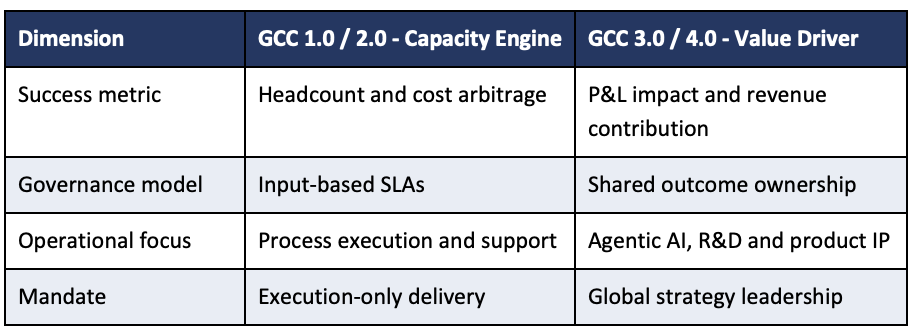
This piece sets out what the underlying data shows about that shift, where most enterprises lose value in the transition, and what a practical operating sequence for practice heads and CXOs looks like.
The traditional shared-services framework was built around input-based SLA compliance: system uptime, ticket volume, cost-per-FTE. Evidence from global delivery performance shows that input-focused governance caps an offshore centre’s contribution at operational parity. It can be efficient, predictable and well run, but it cannot compound in value, because none of those metrics are connected to a business outcome the enterprise cares about at board level.
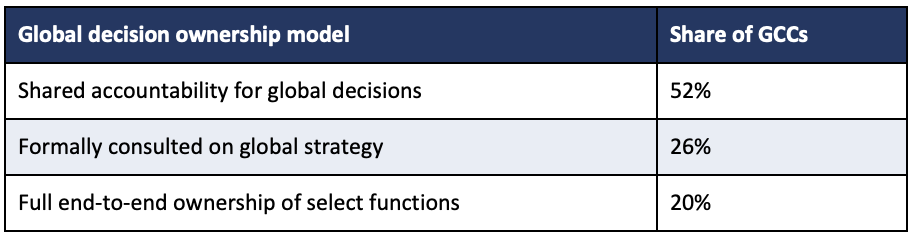
Recent survey data shows Indian GCCs are stepping into genuine decision-making roles, not just larger delivery roles,
- a) Shared accountability: 52% of Indian GCCs now hold shared accountability for global business decisions, and 20% operate with full, end-to-end ownership of selected functions.[1]
- b) Strategy roles: 45% of centres host global strategy leadership roles, and 35% actively manage global talent pipeline development directly out of India. [1]
- c) Engineering-first setups: More than 78% of new GCC setups established in India prioritise digital product engineering, advanced analytics and proprietary R&D ahead of transaction processing. [2]
- d) Market weight: India accounts for an estimated 50-60% of the global offshore GCC market by revenue, centre count and technical talent pool. [4]
Governance and accountability distribution (EY India GCC Pulse Survey) [1]
When a centre operates purely as a staffing function, return on investment scales in a straight line with headcount added, and plateaus the moment hiring slows. When a centre assumes product, architecture or functional domain ownership instead, value generation scales independently of fixed operating cost. This is the structural distinction that separates a GCC 2.0 operation from a GCC 3.0/4.0 one, and it is the single variable that most determines how a centre is discussed at the parent company’s board level.

The technical remit of Indian GCCs has moved well past legacy application support and into core engineering and production-grade AI deployment, and the survey data reflects a market that has already moved past the pilot stage for a meaningful share of this work,
- 1.) Enterprise-grade GenAI: 83% of centres are actively investing in enterprise Generative AI, and 67% have an integrated enterprise data strategy already in place, rather than a set of disconnected departmental initiatives. [1]
- 2.) Agentic AI in production: 58% are actively investing in agentic AI architectures, and 43% have reached production-level GenAI deployment rather than pilot stage, a distinction that matters because pilot metrics rarely predict production economics. [1]
- 3.) Structured innovation transfer: 67% of centres maintain dedicated innovation and incubation teams tasked specifically with taking solutions developed in India and scaling them across global business units, rather than leaving that transfer to chance. [1]
Functional AI adoption in Indian GCCs (EY India GCC Pulse Survey) [1]
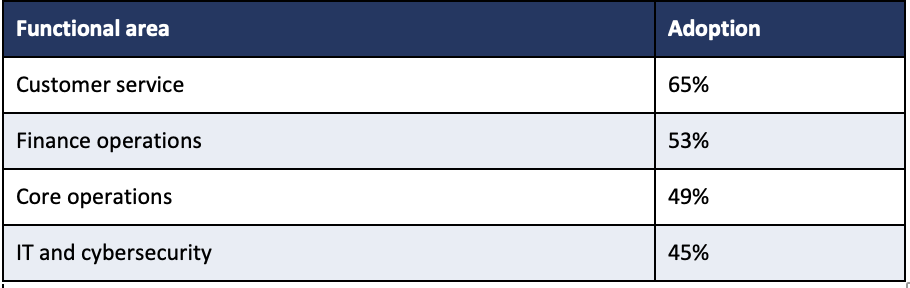
Adoption is not evenly spread across functions, and that sequencing broadly tracks where clean, well-labelled data already existed before AI investment began, worth noting for any centre still building its data foundation.
When a GCC designs an internal platform or agentic workflow that materially cuts global processing time, that centre has stopped functioning as an operating expense. It has become a direct value driver for the enterprise, which is a fundamentally different conversation with the board than a cost review, and it changes how the centre’s budget request is evaluated the following year.
Moving an organisation from headcount-based staffing to verifiable value creation is a structured, three-phase shift, not a single reorganisation announced at a town hall.
Phase 1 – Re-contract governance and metrics
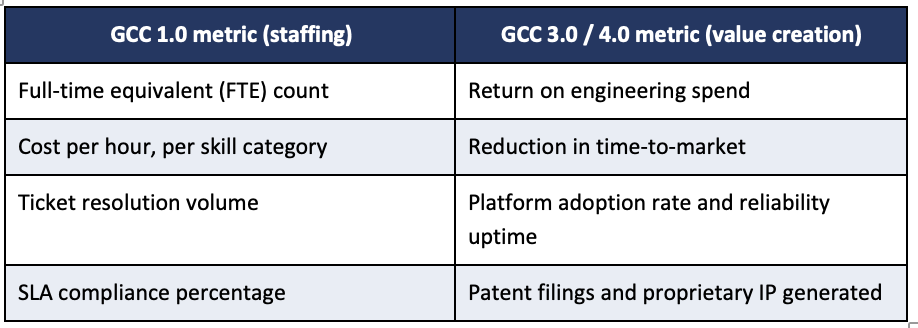
Retire input-driven SLAs in favour of business-outcome KPIs, and align GCC incentives directly with HQ business performance rather than with delivery volume. Vendor contracts and internal transfer-pricing frameworks need to reflect these outcome benchmarks directly, not sit alongside them as a secondary scorecard nobody actually reviews at renewal time.
Staffing metrics vs. value-creation metrics
Phase 2 – Restructure the talent model
An outcome-focused GCC prioritises domain depth and architectural capability over headcount volume. 81% of Indian GCCs are running internal upskilling programmes to move engineers into specialised domain roles such as prompt engineering, data architecture and AI orchestration. [1]
The resulting cost profile changes meaningfully: compensation for specialised technical roles in India can run around 30% above legacy benchmarks, but a smaller team of senior domain architects, supported by modern automation tooling, consistently outperforms a larger team built around junior execution capacity, both on delivery speed and on defect rates. [1]
Phase 3 – Establish full product and P&L ownership
The clearest marker of maturity is when a centre owns a platform end to end, rather than supporting it. Instead of handling defect fixes for a global payments gateway, for example, the GCC takes on architecture, security, deployment and operational uptime as a single accountable unit, with a named leader in India who answers for the platform’s performance rather than for a queue of tickets against it.
Product ownership maturity model
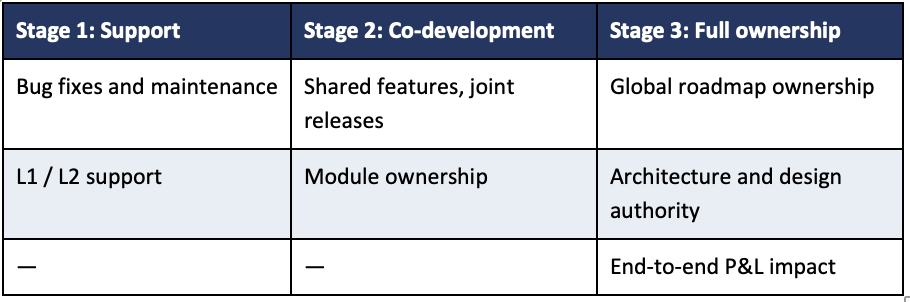
As roadmap ownership moves fully to local teams, cycle times shorten, system resilience improves, and innovation compounds rather than resetting with every release cycle and every change of delivery manager.

About the Author:

PRAKASH THIYAGARAJAN is a strategic business leader who currently serves as Vice President & Head of Digital and Engineering Services (DEX) at Motherson Technology Services . Drawing from 27 years of expertise across technology domains, he orchestrates full-lifecycle engineering solutions in Automotive, Aerospace, Manufacturing, Healthcare and Telecom sectors. His distinguished career, spanning roles at HCL Technologies, Tata Communications and Hexaware, demonstrates his prowess in transforming customer challenges into opportunities. An Electronics and Communication Engineering graduate from the University of Madras, Prakash combines technical acumen with business insight to drive sustainable growth.