
 September 11, 2026
 Neerja Bhalla
The Part That Wasn't There: What Two Decades on the Shop Floor Taught Us About Supplier Portals and VMI
“In high-precision manufacturing, supply chain friction stems less from strategic missteps than from operational information latency. Integrated Supplier Portals and Vendor Managed Inventory (VMI) must move beyond passive portal screens to function as direct execution layers. By enforcing bi-directional ERP synchronisation, upstream master data validation, and clear exception ownership, manufacturing leaders convert real-time visibility into shop-floor velocity. Built on two decades of direct industrial experience, Motherson Technology Services demonstrates how addressing inventory latency optimises working capital, prevents line stoppages, and secures an enduring competitive advantage.”
In manufacturing, supplier issues become visible only once something has already gone wrong: a part is delayed, stock numbers are doubted, confirmations are chased, or production waits for clarity. At Motherson Technology Services, we understand these challenges from direct manufacturing experience, built over more than two decades of creating and consulting on practical IT solutions. Our work on Supplier Portals and Vendor Managed Inventory (VMI) [13] helps organisations move from daily firefighting to clear visibility, ownership, and timely action. If your teams are still chasing suppliers or reacting to shortages after production is affected, digitisation alone will not fix it.
Ask anyone who has spent real time on a shop floor what derails a production plan, and the answer is rarely dramatic. It is a part that has not arrived, a confirmation that never came back, a stock count that looked correct on screen and was wrong on the shelf. Supplier collaboration is not just an IT process. It is an everyday manufacturing reality that must work for every team involved: planners protecting tomorrow’s schedule, buyers chasing a confirmation that should have arrived days ago, quality waiting to know whether a replacement batch will pass inspection in time, finance watching a purchase order that no longer matches what has actually arrived. None of them is wrong. They are looking at the same event through a different screen, with no shared record of what has been agreed, confirmed, or changed.
We at MTSL have seen this from both sides: as part of a large manufacturing ecosystem living these pressures every day, and as the technology team building practical systems to solve them. When we talk about Supplier Portals and VMI, we are not describing another login screen. We are describing the operating layer that connects buyers, planners, suppliers, warehouses, quality, finance, and production around one shared view of requirements, confirmations, dispatches, stock, and exceptions.
The Problem Nobody in Manufacturing Argues With
Most of the people we work with already know what needs to happen next. The gap is rarely knowledge. It is timing. A planner sees a shortage only once it has already disrupted the schedule. A buyer gets a confirmation after three follow-up calls, by which point the delivery window has slipped. A warehouse team finds a stock mismatch only when the material is actually needed on the line. The right information reaches the right person too late, if it reaches them at all.
The data on this is consistent. McKinsey’s Global Supply Chain Leader Survey found that most manufacturers still understand their supply chain risk only as far as their first-tier suppliers, and rated their own supply chain visibility over the next five years as their weakest capability. [1] A separate McKinsey pulse survey found that 82 per cent of supply chain leaders said their networks were already affected by new tariffs. [2] The World Economic Forum reports that more than 40 per cent of organisations have limited or no visibility into their own Tier-1 suppliers’ performance, and that a disruption lasting more than a month, which now recurs roughly every 3.7 years, can cost a business up to 45 per cent of a year’s profit compounded over a decade. [3] The 2025 MHI Annual Industry Report, produced with Deloitte, found that 75 per cent of companies describe supply chain synchronisation as challenging, with more than a quarter calling it very or extremely challenging. [4]
A 2025 survey of 750 US supply chain leaders by Impinj is perhaps the most telling: 95 per cent said their organisation was equipped to drive accurate supply chain visibility, yet only 49 per cent could actually obtain it consistently, in real time. [7] That gap, between confidence and reality, is exactly where line stoppages and expediting costs are born, and why this is no longer an IT budget line: 55 per cent of supply chain leaders are increasing technology investment, and 60 per cent plan to spend more than one million dollars. [4]

What a Supplier Portal Is Actually For
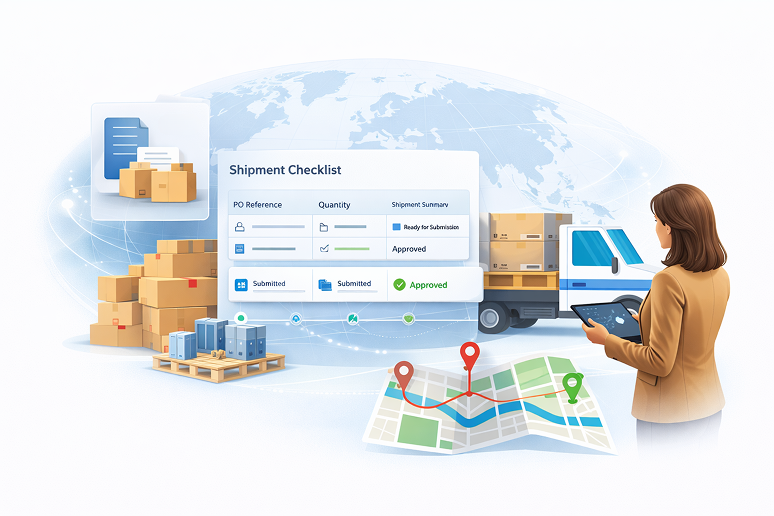
A Supplier Portal, done properly, is not a place where suppliers upload documents and check order status once a week. It is a shared operating view that removes uncertainty across orders issued, confirmations received, dispatches tracked, and quality holds flagged, so teams know what has changed, who owns the next action, and what needs attention before production is affected.
The difference is measurable. In a published case with industrial manufacturer JBT AeroTech, improving purchase order visibility and confirmation tracking reduced missing parts at production start from 31 per cent to 8 per cent, improved supplier on-time parts arrival from 68 per cent to 89 per cent, and lifted customer on-time delivery from 69 per cent to 89 per cent. [8] None of that required new machinery or a change of suppliers, only the right information reaching the right people before the decision became urgent.
Exception handling is where most of this value sits, and where organisations tend to underinvest. When portal workflows automate routine confirmations and flag variances automatically, procurement teams can shift their attention from tactical tracking toward supplier negotiations and sourcing strategy. This is also why supplier relationships now sit higher on the boardroom agenda: Gartner reports that 62 per cent of leading procurement organisations name strengthening relationships with their supply base a top priority. [5]
Where Vendor Managed Inventory Changes the Equation
A good Supplier Portal reduces delay. A good VMI process goes a step further, letting suppliers replenish stock based on agreed inventory bands and genuine consumption signals rather than a purchase order raised after the event. In simple terms, VMI moves the conversation from repeated follow-up to planned replenishment.
McKinsey’s own client work shows the same pattern: one aerospace manufacturer that rebuilt capacity planning around real-time supplier and material data increased shipments by up to 20 per cent and cut expedited-service costs by up to half. [1] These gains matter more in automotive and large discrete manufacturing than almost anywhere else, because the economics of a stopped line are unforgiving. In late 2025, export disputes involving automotive-grade semiconductor shipments led the European Automobile Manufacturers’ Association (ACEA) to warn that component shortages threatened production stoppages across regional vehicle plants, forcing several manufacturers to adjust output. [9] Around the same period, export restrictions on rare earth magnets pushed some European component makers to suspend production while they waited on licences. [10] Neither event began with a strategic failure. Both began with a single category of component, controlled by a small supplier base, becoming visible only once the shortage had already turned critical.
What Actually Makes It Work
This is the part that gets skipped in most vendor pitches, and it takes the most discipline. Successful supplier collaboration is not created by digitising screens. It comes from understanding how the business actually runs: how planners protect the schedule, how buyers chase confirmations, and how production reacts when one part goes missing.
ERP integration has to be bi-directional and real-time, not cosmetic. If a portal does not write back into the ERP instantly, it creates a second version of the truth, and teams are left asking which screen to trust. Master data accuracy is the foundation underneath all of it, and it is weaker than most organisations admit: Deloitte research finds that nearly 70 per cent of manufacturers name data quality as their biggest obstacle to digital transformation, and separate research from the Manufacturing Leadership Council finds that most plant operations still rely on manual data entry. [11][12] Visibility is only ever as reliable as the data feeding it.
Supplier onboarding is another quiet failure point. A portal is only as useful as the suppliers actually working inside it, so onboarding has to be treated as a change initiative, not an administrative task, with suppliers told what is expected of them and how their performance will be measured fairly. Alert design, clear ownership of exceptions, and adoption discipline are what turn a working system into one that is actually used. Gartner surveyed 140 senior supply chain leaders and found that only 17 per cent redesign their workflows when rolling out new technology; the remaining 83 per cent simply layer software onto processes that were never rebuilt to use it. [6] Underperforming roll-outs are rarely caused by the software. They come from unclear ownership and a system treated as finished on the day it went live, rather than the day it earned trust.
Technology Creates Visibility. Experience Converts That Visibility into Action
A dashboard that flags a shortage a day earlier only helps if someone owns the next step, and the process around it matches how the factory actually operates. One missing part can still stop an entire production plan, however advanced the software looks on paper.
For any CXO weighing this investment, the useful question is rarely which platform to buy first. It is whether the business is ready to fix its master data, assign clear ownership, and hold to the discipline of using what gets built. Get that right, and a Supplier Portal or VMI programme pays for itself in avoided downtime alone.
Conclusion
This is where two decades of manufacturing experience shape how we build these programmes at MTSL. Having grown up inside a large manufacturing ecosystem ourselves, we do not treat Supplier Portals and VMI as software to configure and hand over. We build them the way we would want them built for our own operations: ERP integration that writes back in real time, master data work done upstream, and exception ownership designed in from day one. For manufacturers, that translates into lower inventory costs without losing line-side stock availability, less administrative time lost to expediting, and more reliable on-time delivery to customers.

References
[2] https://www.mckinsey.com/capabilities/operations/our-insights/supply-chain-risk-survey
[3] https://www.weforum.org/stories/2025/01/supply-chain-disruption-digital-winners-losers/
[4] https://og.mhi.org/publications/report (2025 MHI Annual Industry Report – The Digital Supply Chain Ecosystem: Orchestrating End-to-End Solutions)
[5] https://www.gartner.com/en/supply-chain/topics/supplier-relationship-management
[8] https://sourceday.com/blog/po-confirmation/
[11] https://www.verdantis.com/master-data-management/master-data-management-statistics-and-market-size/
[13] https://www.techtarget.com/searcherp/definition/vendor-managed-inventory-VMI
About the Author:

With 25+ years in the Motherson Group, Ms. Neerja Bhalla currently CIO and VP, bringing deep industry experience across automobile manufacturing and supply chain eco-system. Her exposure to Japanese business practices and consulting engagements across Europe, ASEAN, the US, and the UK brings a practical global perspective to MTSL’s digital solutions. This experience strengthens MTSL’s ability to design business-focused platforms, such as Supplier Portal solutions, that help enterprises improve collaboration, visibility, and operational efficiency.