Share on facebook
Share on twitter
Share on linkedin

The Myth of the “Hands-Off” Data Centre: Navigating the Realities of Self-Healing Infrastructure

The idea of a fully autonomous data centre is widely accepted yet rarely realised in practice. Outages, cost overruns and operational blind spots continue to challenge even the most automated environments. Self-healing capabilities are advancing, but they remain constrained by data quality, system interdependencies and governance gaps. A more measured approach is emerging, where AIOps and DevOps improve resilience, while human oversight remains critical to sustaining reliable, accountable infrastructure.

The promise of the fully autonomous, “lights-out” data centre has captured the imagination of technology leadership for the better part of a decade. AIOps platforms, self-healing runbooks, and agentic AI workflows have materially advanced the art of autonomous infrastructure management. Yet as we move through 2026, the empirical evidence points to a more measured conclusion: the “hands-off” data centre is, at this moment, a strategic misnomer rather than an operational reality.

The data is unambiguous. Outage frequency has declined for the fourth consecutive year relative to total digital workload volume [11], but the financial severity of each failure has increased sharply, with 54% of all reported outages now exceeding $100,000 in direct costs [3] and approximately 20% surpassing the $1 million threshold. [11] This is the resilience paradox of the modern era: fewer incidents, but each one capable of systemic damage.

What separates organisations that successfully reduce outage risk from those that do not is the sophistication of their automation tooling alone. It is the quality of the human-machine partnership governing that automation.

The Resilience Paradox: Lower Frequency, Higher Stakes

Data from the Uptime Institute’s 2025 Annual Outage Analysis [11] confirms that the overall frequency of outages has declined relative to the expanding volume of digital workloads processed globally. This is, on the surface, an encouraging trajectory. However, it masks a more troubling shift in the severity distribution of incidents that occur.

Consider the following industry benchmarks for 2025-2026,
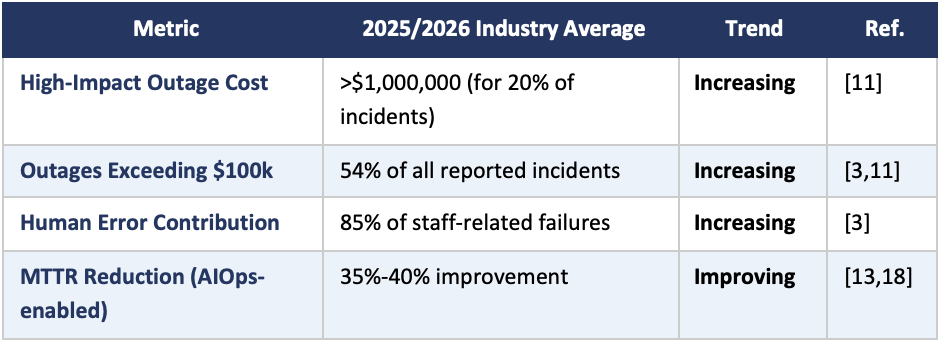
Table 1: Key Infrastructure Outage Metrics, 2025-2026 Industry Average


The October 2025 AWS infrastructure incident crystallises the financial exposure at stake. Analysts estimated insured losses attributable to the event in the range of $38 million to $581 million globally, a spread that itself reflects the measurement complexity of cascading Cloud dependency failures. [11] For the C-Suite, this is not an edge-case risk scenario; it is a tail risk with a material probability of occurrence for any organisation operating complex, multi-Cloud estates.

Human error remains the dominant failure vector, contributing to 85% of staff-related infrastructure failures [3,7], a figure that rose by ten percentage points between 2024 and 2025. [3] This is not a finding that implicates individual negligence. It is a systemic indicator that procedures are either absent, inadequate, or not followed, a condition that automated systems alone cannot resolve without a corresponding investment in engineering governance and process redesign.

The AIOps Nervous System: From Alert Noise to Actionable Intelligence

The enabling technology layer for self-healing infrastructure is what Gartner now classifies as Event Intelligence Solutions (EIS), formerly described under the broader AIOps umbrella. The EIS market is forecast to grow from $11.08 billion in 2025 to $14.44 billion by late 2026, representing a CAGR of 30.2%. [13,18]

This growth reflects a genuine shift in enterprise capability requirements. The primary value proposition of modern EIS platforms has moved decisively beyond alert monitoring. Leading implementations now focus on three distinct capability layers,

  • 1. Event noise reduction – Top-tier platforms demonstrate a 95% reduction in alert event volume, filtering the digital static that historically leads to alert fatigue and consequent human error. [12]
  • 2. Causal correlation – Machine-learning models correlate events across heterogeneous tool stacks, network, compute, application, and security layers to identify probable root causes before incidents escalate to outages.
  • 3. Autonomous remediation – Predefined runbooks trigger automated corrective actions, reducing the response window from minutes to seconds for well-catalogued fault patterns.
  1. A) The Shift to Agentic AI
  2.  

The next inflection point is already in motion. Forrester’s 2026 technology predictions [15,20] signal a transition from deterministic, rule-based automation to cognitive autonomy, what practitioners are beginning to describe as “agentic AI.” The distinction is material:

  • a) 25% of technology leaders now expect AI agents to function as autonomous decision-making members of their operational teams by the end of 2026. [14]
  • b) Forrester forecasts that at least one major global infrastructure outage will be averted entirely by an agentic AI workflow acting without human sign-off during the same period. [14]
  • c) Approximately 20% of enterprises are expected to adopt “Private AI Factories”, on-premise or sovereign-Cloud AI inference environments to manage sensitive infrastructure telemetry without external data exposure. [19]
  •  

The critical operational distinction here is between automation and autonomy. Automation executes predefined logic. Autonomy exercises contextual judgement. For infrastructure, this difference determines whether a self-healing system can handle novel fault scenarios, or whether it merely resolves the incidents it was explicitly trained to expect.

  1. B) Cloud Complexity as a Structural Amplifier

The adoption of multi-Cloud architectures has increased the surface area that self-healing systems must cover. Flexera’s 2025 State of the Cloud Report [8] indicates that 84% of enterprises report significant difficulty managing and optimising Cloud spend across providers, a proxy measure for the underlying operational complexity. [4] Meanwhile, Cloud-native adoption continues to accelerate: the CNCF Annual Survey 2024 [6] confirms that Kubernetes is now used in production environments by a substantial majority of enterprise respondents, adding container-layer complexity to the monitoring and remediation challenge.

The Grafana Observability Survey 2024 [5] found that the average enterprise operates across three to five distinct Cloud environments simultaneously. Each environment generates proprietary telemetry in different formats, schemas, and retention policies, making unified event correlation the foundational technical prerequisite for any self-healing capability.

The Human Factor: The 1:5 Investment Rule

If the technology case for self-healing infrastructure is well-established, the organisational case is where most programmes fail. McKinsey’s 2026 State of Organizations [13] delivers a finding that should occupy a prominent position in every CTO’s strategic planning cycle:

While 88% of surveyed leaders have initiated some form of AI deployment in their infrastructure operations, 86% simultaneously acknowledge that their organisations are not adequately prepared to integrate AI-driven systems into their daily operating model. [13] This is not a technology gap; it is a capability and governance gap.

The most consistently successful practitioners, those achieving the measurable MTTR improvements referenced in Section 1, follow a specific capital allocation principle,

This ratio reflects the operational reality that automation does not remove human judgement from infrastructure management. It changes the nature of that judgement. The role transitions from “operator responding to alerts” to “orchestrator governing autonomous systems”, a role requiring deeper contextual knowledge of business processes, risk thresholds, and system interdependencies, not less.

  1. A) Engineering Governance as the Critical Control Layer

The 85% human error contribution rate cited by the Uptime Institute [3,7] is often misread as an argument for removing humans from operational processes. The correct reading is precisely the opposite. The data shows that failures occur because procedures are poorly designed, inadequately communicated, or not followed under pressure. Automation can accelerate the execution of a flawed procedure to catastrophic speed.

Engineering Governance, in the context of self-healing infrastructure, comprises four non-negotiable components,

  • 1) Runbook accuracy and lifecycle management: Self-healing systems are only as effective as the remediation logic they execute. Runbooks require continuous expert review and refinement as the infrastructure estate evolves.
  • 2) Confidence thresholds and human escalation triggers: Autonomous actions must operate within defined confidence bands. Below threshold confidence, the system must escalate to a human engineer with full contextual telemetry surfaced.
  • 3)” Blast radius containment: Every autonomous remediation action carries a risk of compounding adjacent system failures. Governance frameworks must define and enforce scope limits for automated actions.
  • 4) Post-incident learning loops: DORA metrics, deployment frequency, lead time for changes, change failure rate, and time to restore must be instrumented to continuously measure and improve the effectiveness of autonomous remediation over time. [2]

Three Strategic Hurdles for the C-Suite

The path from aspiration to operational self-healing infrastructure is obstructed by three structural challenges that technology investment alone cannot address. Each requires deliberate executive attention.

  1. A) Integration Debt and Tool Proliferation
  2.  

Large enterprises commonly operate portfolios of five to fifty discrete monitoring and observability tools, accumulated across years of point-solution procurement and acquisition integration. This fragmentation represents the primary technical bottleneck to genuine self-healing capability. [5]

Without a unified telemetry and event data layer, AIOps engines cannot correlate signals across system boundaries with sufficient accuracy. The consequence is “fragmented automation”: a condition where one system’s remediation action triggers an unintended failure in an adjacent system that the AIOps platform cannot observe. This is arguably more dangerous than no automation at all, because it creates the false appearance of operational control.

The strategic imperative is to rationalise the observability stack before scaling self-healing capabilities. This is a multi-year programme for most enterprises, not a technology decision but a capital allocation and organisational change decision requiring sustained executive sponsorship.

  1. B) Regulatory Scrutiny and the “Kill Switch” Mandate
  2.  

Infrastructure is no longer a purely private corporate concern. In 2025, regulatory frameworks began formally codifying the boundaries of autonomous decision-making in critical infrastructure environments. Two developments deserve executive attention.

  • 1) Texas Senate Bill 6 (SB6): Mandates the implementation of “kill switch” functions for data centre operators to protect grid integrity during peak demand events, a direct legislative intervention into autonomous infrastructure management.
  • 2) EU Digital Operational Resilience Act (DORA): Requires financial sector entities and their ICT service providers to maintain ultimate human accountability for operational decisions, including those executed by automated systems. [2] The “the AI did it” defence carries no legal or regulatory weight under DORA.


The policy trajectory is consistent across jurisdictions: regulators will not permit “full autonomy” for infrastructure decisions that affect national resilience or financial system stability. CTOs must architect their self-healing systems with explicit, auditable human override and accountability mechanisms from the outset, not as an afterthought.


  1. C) The Talent Transition: From Operators to Orchestrators


By late 2026, the infrastructure industry anticipates a transition from “Vibe Coding”, the use of natural language prompting to generate software to “Vibe Engineering”: the use of natural language and contextual signals to configure, govern, and interrogate complex infrastructure environments. [18]

This shift has a direct talent implication. The scarcest resource in the self-healing infrastructure landscape is not the AIOps platform; it is the engineer who can,

  • 1) Translate business context and risk tolerance into automation confidence parameters and escalation policies
  • 2) Identify when autonomous remediation has introduced systemic risk rather than resolved it
  • 3) Design and maintain the learning feedback loops that improve system accuracy over time
  • 4) Engage with regulators and auditors regarding the governance of autonomous decisions
  •  

This profile – part engineer, part risk manager, part product owner, does not emerge from traditional infrastructure operations career paths. Building it requires deliberate workforce transformation investment, not merely hiring.

The Power Infrastructure Dimension

No discussion of self-healing data centre infrastructure in 2026 is complete without addressing power. Data centre power demand is projected to grow at a CAGR of 15-20% through 2030, driven by AI inference workloads and the rapid expansion of hyperscale capacity. [16] This demand trajectory is creating a physical infrastructure constraint that software-defined self-healing cannot mitigate.

The self-healing grid market, technologies designed to autonomously detect and isolate faults in power distribution networks is projected to reach $11.85 billion by 2029 [15], reflecting the scale of investment required to stabilise the power delivery layer beneath the software stack. For data centre operators, this means self-healing infrastructure must extend the definition of “system boundary” to include UPS topology, cooling management, and grid interconnects, domains historically managed by facilities engineering rather than IT operations.

The convergence of IT operations and facilities management driven by shared exposure to power-related failure modes represents one of the most significant organisational design challenges for data centre leadership in the near term. [16]

Conclusion

The “hands-off” data centre is a myth because infrastructure is not a static artefact. It is a continuously evolving system that responds to every new application deployment, every security threat, every regulatory mandate, and every shift in business process. The appropriate strategic objective is not full autonomy; it is Guided Autonomy, a model in which algorithmic speed and scale operate within governance structures designed by, and accountable to, human experts.

The evidence for what Guided Autonomy can achieve is compelling,

  • 1) AIOps-enabled environments demonstrate 35-40% MTTR reductions and 95% alert noise reduction, freeing engineering capacity for high-judgement work. [13,18]
  • 2) Organisations that apply the 1:5 technology-to-people investment ratio achieve measurably better outcomes than those that invest in platforms alone. [13]
  • 3) The transition from deterministic automation to agentic AI, where 25% of tech leaders expect autonomous agent-level capability by end-2026 creates the potential for proactive outage prevention rather than reactive remediation. [14]
  •  

However, realising these outcomes requires what can best be described as a Double Transformation: simultaneously upgrading the technical stack and the human operating model. Organisations that address only one dimension deploying sophisticated AIOps without restructuring governance, or investing in people without rationalising the tool stack, consistently underperform relative to those that execute both in parallel.

Motherson Technology Services brings this dual-transformation capability to its infrastructure and Cloud engagements. By integrating AIOps-driven event intelligence with structured engineering governance frameworks, Motherson enables enterprises to operationalise self-healing infrastructure without the governance blind spots that undermine most implementations. The DevOps maturity models, DORA metric instrumentation, and regulatory compliance architecture that Motherson deploys across manufacturing, financial services, and technology-sector clients provide the organisational scaffolding that transforms sophisticated automation into durable operational resilience.

For clients navigating multi-Cloud complexity, tool-stack fragmentation, and accelerating regulatory scrutiny simultaneously, Motherson’s integrated approach, combining platform rationalisation, AIOps implementation, and workforce capability development delivers the competitive differentiation that neither technology nor organisational change achieves in isolation.

References

[1] https://dsg.tuwien.ac.at/Staff/sd/papers/Zeitschrift%20Computing%20H.%20Psaier.pdf

[2] https://dora.dev/insights/dora-metrics-history/

[3] https://datacenter.uptimeinstitute.com/rs/711-RIA-145/images/2024.Resiliency.Survey.ExecSum.pdf

[4] https://www.flexera.com/about-us/press-center/new-flexera-report-finds-84-percent-of-organizations-struggle-to-manage-cloud-spend

[5] https://grafana.com/observability-survey/2024/

[6] https://www.cncf.io/wp-content/uploads/2025/04/cncf_annual_survey24_031225a.pdf

[7] https://datacenter.uptimeinstitute.com/rs/711-RIA-145/images/2024.GlobalDataCenterSurvey.Report.pdf

[8] https://www.flexera.com/blog/finops/the-latest-cloud-computing-trends-flexera-2025-state-of-the-cloud-report/

[9] https://arxiv.org/abs/2406.11213

[10] https://arxiv.org/abs/2308.00393

[11] https://uptimeinstitute.com/about-ui/press-releases/uptime-announces-annual-outage-analysis-report-2025

[12] https://www.selector.ai/landing-pages/2025-gartner-market-guide-for-event-intelligence-solutions/

[13] https://www.unleash.ai/strategy-and-leadership/mckinseys-the-state-of-organizations-2026-research-three-decisions-to-make-now/

[14] https://www.forrester.com/predictions/

[15] https://www.fortunebusinessinsights.com/industry-reports/self-healing-grid-market-101649

[16] https://www.enersys.com/en/blog-articles/data-centers-five-trends-reshaping-power-cost-and-resilience/

[17] https://www.selector.ai/blog/navigating-the-future-of-event-intelligence-solutions-gartners-insights-and-selectors-leading-role/

[18] https://www.businesswire.com/news/home/20260303475304/en/Levelpath-Launches-Agent-Orchestration-Studio-as-a-Fast-Track-to-Agentic-Procurement

[19] https://itbrief.asia/story/forrester-tips-ai-native-clouds-digital-workers-by-2026

About the Author:

Rahul Arora

Practice Head – DevOps

Motherson Technology Services

Rahul spearheads Motherson’s global Cloud DevOps initiatives, driving large-scale transformations for enterprises across industries. With deep expertise across AWS, Azure, and multi-cloud ecosystems, he has led mission-critical programs in migration, automation, DevSecOps, and cost optimization, ensuring resilience and efficiency at scale.

A passionate technologist with a strong techno-managerial edge, Rahul blends hands-on engineering depth with strategic leadership. He has been instrumental in shaping AI-driven DevOps automation frameworks and enterprise-grade compliance solutions, consistently bridging technology execution with boardroom priorities to maximize customer value.

Insights

Trends and insights from our IT Experts